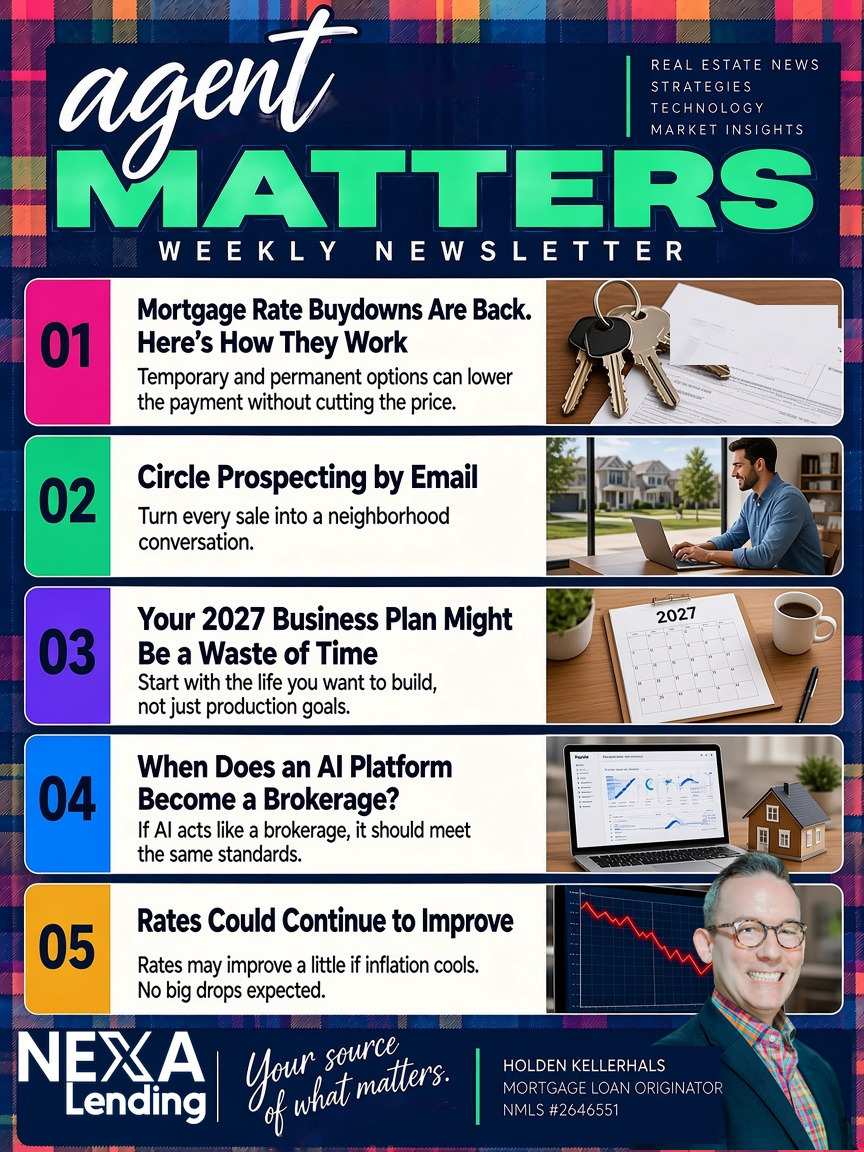
This week’s Agent Matters looks at why mortgage rate buydowns are making a comeback and how understanding temporary and permanent options can help agents keep deals together when affordability gets tight. We break down how a simple neighborhood email strategy can turn recent sales into new listing conversations, why your 2027 business plan should start with the life you want to build, and how turning knowledge into action creates better results. You’ll also see why AI platforms are raising serious questions about agency relationships and consumer protection, how agents can protect their role in the transaction, and why cooling inflation and falling oil prices could help mortgage rates continue their gradual improvement.
Stories That Matter
Mortgage Rate Buydowns Are Back. Here’s How They Work
With rates above 7%, mortgage rate buydowns are making a comeback. A buydown is an upfront payment at closing that lowers the buyer’s interest rate. Buyers, sellers, builders and lenders can all pay for one.
There are two types. A temporary 2/1 buydown drops the rate 2 points in Year 1 and 1 point in Year 2, with funds held in a custodial account. After that, the payment returns to the full note rate. A permanent buydown uses discount points. One point costs 1% of the loan amount and typically lowers the rate about 0.25% for the life of the loan.
Nothing new here. Buydowns were common in the early 1980s, when two-thirds of homebuilders offered them. Today, 44.7% of August sales carried a seller concession, and builders are offering $10,000 to $20,000 to clear inventory.
Here’s the math on a $500,000 loan at 7%. The normal payment is about $3,327. A 2/1 buydown cuts it to roughly $2,684 in Year 1 and $2,998 in Year 2, costing about $11,650 total. One permanent point costs $5,000.
Buyers usually need to ask for one. Write a seller concession for non-recurring closing costs into the initial offer, or request one during the inspection or loan contingency period. Sellers often prefer a buydown over a price cut because it protects the list price while still lowering the buyer’s monthly payment.
Why This Matters: Buydowns can save deals when rates climb. Know the difference between temporary and permanent options, and partner with a lender who can show clients a clear breakeven analysis before they commit.
Strategies That Matter
Circle Prospecting by Email:
Turn Every Sale Into a Neighborhood Conversation
After closing a sale in Norwalk, California, one team emailed 500 nearby homeowners to share the news. Thirty replied, and one conversation turned into a listing appointment. Across several Just Listed, Just Sold, and open house campaigns, they’ve now emailed roughly 2,000 neighbors and received 105 replies. Postcards and open houses still have their place, but your listings can also start conversations directly in homeowners’ inboxes.
Lead with a real reason to reach out. Skip the generic introduction or unsolicited valuation. The email simply said the team had just closed a nearby sale, saw more interested buyers than homes to show, and offered to run the numbers if the homeowner had considered selling. The subject line was the homeowner’s own address. Short, relevant, and easy to reply to.
Build it carefully, even without special software. Start with your title rep to identify homes around a listing. A list of 100 is a fine starting point. Match properties to ownership info, find emails through a reputable data provider, and verify them to protect deliverability. Use a separate business email with proper domain authentication, never your personal inbox. Track everything in a spreadsheet, and make sure the campaign follows commercial email rules, including accurate sender details, a physical address, and a working opt-out.
The follow-up is where the appointment happens. When a homeowner asked them to run the numbers, the agent didn’t fire off a CMA. Instead, they asked for a quick call to learn about the home’s condition. That one question moved an email exchange into a real conversation and, eventually, a listing appointment.
Why This Matters:
A listing gives you a reason to reach out, but what you do when someone answers determines whether it becomes business. Not every reply is a seller, and some neighbors will ask not to be contacted, which you should always respect. Start small, measure actual replies instead of opens, and put as much energy into your follow-up as you do into the technology. This isn’t a replacement for postcards. It’s one more way to reach neighbors you might otherwise miss.
Lessons That Matter
“The people you admire deal with fear, doubt, and uncertainty too. They just stopped expecting confidence to show up first. Progress often comes from moving while those feelings are still present. Courage gets romanticized, but most of the time it looks ordinary: showing up, staying committed, and refusing to let doubt make the decision.”
Books That Matter
The Diary of a CEO: The 33 Laws of Business and Life - Success in real estate requires more than market knowledge and sales skills. The Diary of a CEO explores the principles behind high performance, helping agents strengthen their mindset, understand human behavior, make better decisions, and build habits that support long-term growth.
Podcasts That Matter
Your 2027 Real Estate Business Plan Might Be a Waste of Time - Every year, real estate agents spend hours creating business plans, setting production goals, and promising themselves that next year will be different. But what if the reason they keep falling short has nothing to do with their plan? In this video, you'll discover three questions that challenge the traditional approach to real estate business planning and help you think differently about what you're actually working toward. Before setting your 2027 goals, it's worth considering whether those goals align with the life you want to build. Because a successful real estate business should support your vision for your life, not become your entire life.
AI That Matters
When Does an AI Platform Become a Brokerage?
At a regulators’ conference this year, attendees watched a demo of an AI caller trying to convince a consumer to work with an agent. The voice was polished and effective. It asked about her goals, finances, and timeline, and handled hesitation naturally.
Then she mentioned she already had an agent. The AI said that was no problem and kept going. It never asked if she had signed an exclusive representation agreement.
Regulators immediately raised concerns about agency disclosure, ethics, and supervision. But here’s the bigger question: What if that AI didn’t belong to a brokerage at all?
The line is blurring. Regulators have tolerated unlicensed lead generation companies that simply collect inquiries and pass them to agents. AI is moving far past that lane. It can now recommend homes, analyze pricing, suggest offer strategies, and draft contract language without a human agent ever joining the conversation.
Who owns the client relationship? After weeks of guidance from a platform, consumers will assume it’s working for them, even if its real business is advertising or selling leads. Agents may show up only to unlock doors or sign documents. That turns platforms into digital gatekeepers. They control when and how you get introduced.
The playing field isn’t level. Nearly all AI regulation targets people who already hold licenses. California regulators say agents are responsible for the accuracy of AI-generated content. Meanwhile, platforms performing similar work may avoid disclosure rules, advertising standards, and discipline.
What this means for you: Own your client relationships directly. Use AI as your tool, not someone else’s front door. Stay present from first call to closing. And if a platform’s AI is talking to your clients, know what it’s telling them.
Bottom line: When an AI platform acts like a brokerage, it should face the same standards and accountability as one.
Videos That Matter
How To Become Dangerously Self-Educated (with AI) - Learning more doesn't always mean making progress. In this video, the host explains why consuming endless courses, podcasts, and books often fails to produce meaningful change. Viewers will discover how traditional learning habits can create a gap between knowledge and action, and how AI can help close it. The focus is on turning information into understanding, improving retention, and applying what you learn so it produces real results instead of becoming more knowledge you never use.
Market Updates That Matter
Last Week's Mortgage Rate Recap: Rates improved 👍
Mortgage rates continued to move lower last week, despite stronger-than-expected BLS jobs data showing the labor market remains strong and raising the possibility of future Fed rate hikes. Rates have been slowly but steadily improving since reaching their highest levels in early October.
This Week's Mortgage Rate Forecast: Rates could continue to improve 👍
Mortgage rates could continue to improve this week, especially if data shows inflation is cooling. However, even if rates do move lower, don't expect any big drops. Instead, we're more likely to see the same slow, steady improvement we've seen over the past few weeks.
What’s affecting rates this week:
Inflation: Consumer inflation data comes out Tuesday, followed by wholesale inflation on Friday. Tuesday's CPI report will have the biggest impact on rates, but if either report surprises markets and shows higher inflation, it could pressure rates slightly higher.
Middle East: Oil prices have fallen significantly over the last couple of weeks and could continue to move lower as markets grow more optimistic that a diplomatic solution will be reached.
Veterans Day: Bond markets will be closed Wednesday in observance of Veterans Day.