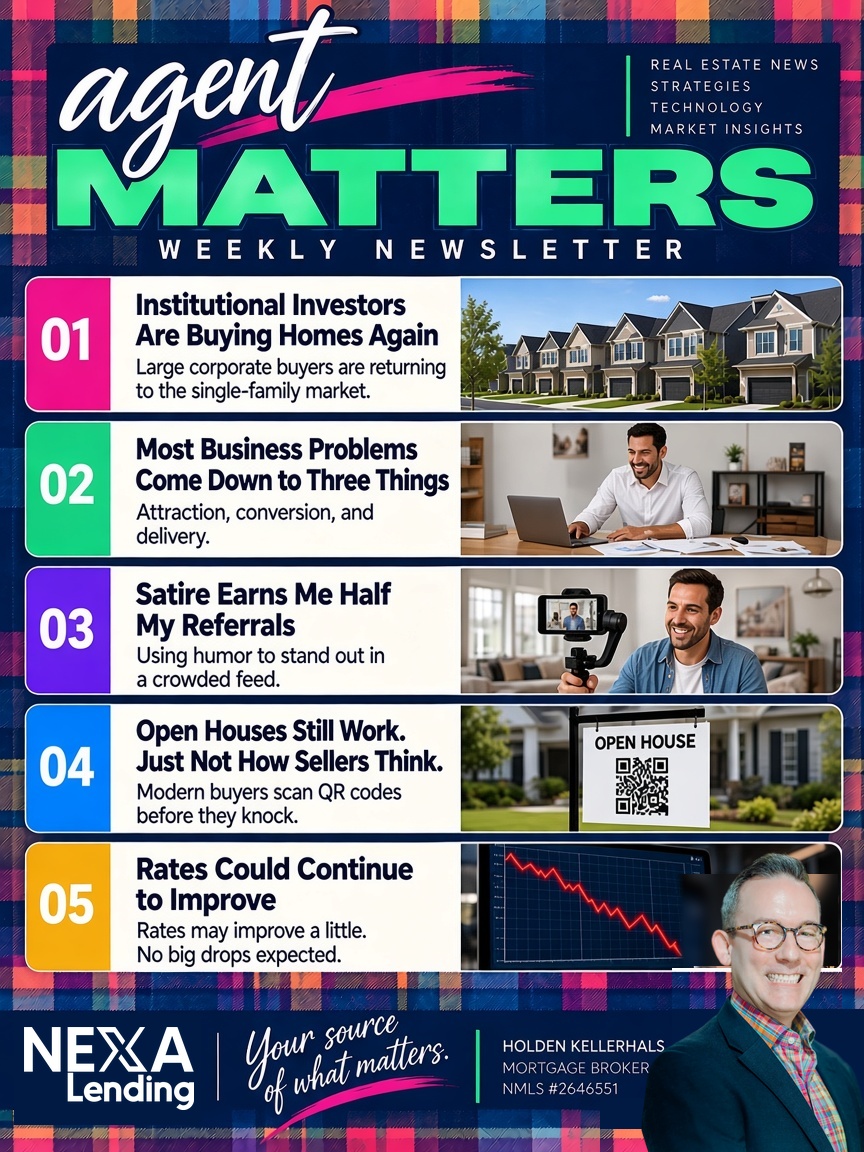
This week’s Agent Matters looks at why institutional investors are returning to the housing market and what their growing interest in build-to-rent communities could mean for buyers and local inventory. We break down the three areas that determine business growth, why fixing conversion problems matters more than buying additional leads, and how humor and authentic content can generate referrals. You’ll also see how AI can help turn open houses into stronger relationship-building opportunities, why better decision-making starts with clearer thinking, and how jobs data, oil prices, and tech stocks could help mortgage rates continue their recent improvement.
Stories That Matter
Institutional Investors Are Buying Homes Again
After a slowdown earlier this year, institutional investors are back. Mega investors, those owning 1,000 or more homes, bought 2.2% of single-family homes in August, according to Cotality. That’s up from a 2026 low of 1.4% in February.
Realtor.com economists point to two drivers. First, individual buyers are pulling back over affordability concerns and rate volatility, leaving more inventory for investors who often pay cash. Second, passage of the 21st Century ROAD to Housing Act removed policy uncertainty, letting investors adjust their strategies.
“It’s also possible that institutional activity slowed while policy was unclear and in flux, and that these investors have returned now that it’s settled,” said Realtor.com senior economist Hannah Jones.
Whether this is a true rebound remains unclear. Jones said transaction volume will show whether investor activity is growing or the rest of the market is simply shrinking around them.
Either way, the next wave likely won’t mirror 2021 and 2022. With Americans delaying homeownership until around age 40 and the new law preserving build-to-rent exceptions, investors may focus on BTR communities. BTR starts fell 16% year over year in August, but activity is shifting rather than disappearing. Sunbelt markets like Austin, Phoenix and Orlando are cooling, while North Dallas, Boise and Denver hold up. Investment is flowing toward Long Island, suburban Chicago, Charlotte, Denver and Tulsa. BTR occupancy sits at 92.6%.
Why This Matters: Cash-heavy investors can outbid first-time buyers, especially when rates top 7%. Know which local neighborhoods are seeing investor and build-to-rent activity, and help buyers prepare stronger offers or explore new construction alternatives.
Strategies That Matter
Most Business Problems Come Down to Three Things
Real estate coaches love complicated plans with dozens of steps. But whether you’re building a business, fixing declining production, or scaling a team, most operational problems fall into three basic areas: attraction, conversion, and delivery. Running a real estate business isn’t easy, but diagnosing what’s wrong shouldn’t require a 37-point plan. Once you know which area is struggling, you can fix the actual problem instead of throwing money at the wrong one.
Attraction: Are enough people finding your business? This covers prospecting calls, social content, ads, open houses, referrals, and networking. Many agents debate which lead gen strategy is best when the real problem is they aren’t consistently doing anything. If nobody knows you’re in real estate, you’re a “secret agent.” The fix might be daily prospecting or a referral strategy, not an expensive lead system. But if you already have plenty of leads and can’t close, buying more just adds people to a system that isn’t working.
Conversion: Are you turning attention into actual business? This is where most agents struggle. Real estate has a long conversion timeline, and consumers may research for months or years before deciding. Calling a lead a few times and labeling them “bad” when they don’t respond is often a conversion system problem, not a lead quality problem. Provide value consistently and build genuine relationships without constantly asking for business.
Delivery: Can your business handle the clients you attract? This includes showings, negotiations, paperwork, and communication. For solo agents, it looks like falling behind on paperwork. For teams, it’s agents carrying too many clients. A transaction coordinator or showing assistant often helps, as long as the hire makes financial sense.
Why This Matters:
Agents with conversion problems buy more leads. Agents with attraction problems buy new CRMs. Team leaders with delivery problems spend more on advertising. Those investments rarely work because they target the wrong part of the business. Before adding another system, identify which of these three areas is holding you back. Sometimes the fastest way to grow isn’t adding something new but fixing what’s already broken.
Lessons That Matter
“Rest is part of recovery. Avoidance slowly trains you to back away from pressure. The difference usually comes down to what happens next. Rest should help you return stronger, clearer, and ready to engage. Avoidance keeps extending the distance between you and the work until retreat starts feeling normal.”
Books That Matter
The E-Myth Revisited - Being a great agent doesn't automatically make you a great business owner. The E-Myth Revisited teaches agents how to build systems, create repeatable processes, and work on their business instead of constantly working in it, creating room for sustainable growth.
Podcasts That Matter
Satire Earns Me Half My Referrals - Most real estate agents think video marketing means listing tours, market updates, or chasing the latest social media trend. Bob Tompkins built his business doing something completely different: making people laugh. In this episode of Real Estate Insiders Unfiltered, Bob explains how creating more than 250 comedy sketches helped him build an audience and generate agent referrals that once accounted for roughly half his business. He shares why consistent content creation matters more than going viral, how creativity improves through repetition, and why agents should build content around what they genuinely enjoy. His approach proves that standing out starts with being memorable, not copying everyone else.
AI That Matters
Open Houses Still Work. Just Not How Sellers Think.
Most buyers have walked through the listing online before they ever park out front. So the open house rarely sells the home. What it gives you is face time. The best agents mix old-school hustle with AI tools that make visitors remember them.
1. Knock on neighbors’ doors first. A few days before, invite them to a neighborhood exclusive preview. They want to see it anyway. Give them a heads-up about parking. No pitch. Neighbors remember the agent who was considerate.
2. Open when buyers can actually come. Sunday 1 to 4 is a habit, not a rule. One agent opened a listing Thursday from 5 to 7 p.m., caught commuters, and went under contract days later. Check when showing requests come in.
3. Build a landing page with AI. In about an hour, include nearby sales, disclosures, HOA documents, commute times, local spots, and a short video of you. Put the QR code on the sign, door, and counter. Serious buyers scan for comps, so you get real names. Post offer deadline updates there too. Verify every number against the MLS. Keep neighborhood info about places, not people, for fair housing.
4. Show visitors what the house could be. Hate the paint? Snap a photo and let AI show the room in blue. Dated kitchen? Let AI “renovate” it on a tablet. It turns an objection into a conversation. Label these as concepts, never promises.
5. Follow up that night. Text every visitor and mention something they said. AI can draft it from your notes, but make sure it sounds like you. Send the seller a quick recap Monday morning. Include visitor counts and price feedback.
Bottom line: Stop asking the open house to sell the house. The door knock and the follow-up text make people remember you long after Sunday.
Videos That Matter
How The Top 1% Think on Paper - Having a vision is easy. Turning it into a working plan requires clear thinking and better decisions. In this video, the host explains why writing plans on paper exposes gaps that digital tools often hide. Viewers will learn the leadership dumbbell framework, how to delegate decisions without losing control, and why teams should bring recommendations instead of options. These practical strategies help business owners improve decision-making, reduce distractions, and build companies that operate more effectively.
Market Updates That Matter
Last Week's Mortgage Rate Recap: Rates improved 👍
Mortgage rates ended the week slightly lower for the fourth straight week, although once again it wasn't a smooth ride. Rates crept higher after Wednesday's Fed meeting before improving Thursday and Friday as AI and tech stocks sold off and investors moved money into bonds.
This Week's Mortgage Rate Forecast: Rates could continue to improve 👍
Mortgage rates could continue to improve this week, but they'll need some help from weaker jobs data and falling oil prices. While we could see rates move a little lower, don't expect any big drops. Instead, we could see more of the gradual improvement we've seen throughout October.
What’s affecting rates this week:
Labor data: It's a big week for jobs data, with Friday's BLS jobs report likely to have the biggest impact on mortgage rates. Weak numbers could help rates, while strong numbers could push them higher.
Oil: Oil prices are starting the week lower on hopes for a U.S.-Iran deal, but concerns about possible military action after the midterms could push prices higher again.
Stocks: AI and tech stocks could continue to influence rates this week. More selling could help mortgage rates improve, while a rebound could push rates higher.